Showing posts with label Myth and Mythological Creatures. Show all posts

Monday, June 26, 2017

Mythical Monday #76 - Fairies

Art work by: @Burntlaughter on Twitter

It seems there are many books influenced by or based on Myths and Mythological Beings.

There are many different Mythology's and Mythological Beings recorded. Some are very popular and well known, others not so much. There are many similar beings, yet different depending on the culture it’s based in.  The definition of Myth covers about anything in the Urban Fantasy/Fantasy realm to me.

I’ve invited authors to share briefly the Mythological being or Myth that influenced their character(s) or story, or what their character(s) are based on influencing their books.  Hosting here, one author and being or myth per week.


Fairies.

I think everyone has a different vision of fairies. Some good. Some bad. Some…straight up naughty. I hear people in Oregon talk about fairies in nature all the time. Often calling to, or wishing upon them like they are guardian angels or leprechauns. I have to admit, this is kinda lost on me. Why fairies in those situations? Why not elves or gnomes or even trolls?

So how do I envision fairies?

Well, Fairy God Mothers never sounded appealing to me. Maybe they should be called guardian angels? Cause when I close my eyes and try to picture a fairy, Rue Mcclanahan in a lavender hooded cape is the furthest thing from my mind. (Golden Girls actress reference. You are welcome!)

When I search fairies on the internet, I end up seeing lots of naughty fairy Halloween costumes, which have measly little wings, and let’s be honest, they aren’t lifting no one off the ground! ;) Not really my idea of a fairy either.

I guess there are all sorts of possibilities, however, in pop culture, we have been inundated with children’s movie fairies and they all start to look alike after a while… Those fairies are normally tiny, like action figure height or smaller, but built proportionate to an average human.

Gah! Hold up.

I had to stop writing this article and search the web for something. See, my old Dungeons and Dragons background refuses to let me think of anything other than this one classic D&D chart right now (see below). Humans and half-orcs compared to the sizes of elves and half-elves…of course, I’d need to draw the fairy in for size comparison.

Okay… moving on….

Fairies.

Basically, many of us think of Tinkerbelle right out of the gate. I know I sure do. Small, blonde, elf ears...whimsical. Fairies whose wings are often depicted as butterfly or dragonfly-shaped, translucent, and made of some sort of magical sparkling pixie dust that chimes.

So cute!

blah… lol.

I ask you this!?!? What if fairies evolved? What if they stopped being the size of humming birds and started getting larger? What if natural selection inched them away from being simple prey to things like owl, hawks, eagles, and cats, to something more…well…more durable.

In the first two books of my Urban Fantasy series, I build on a modern history of fairy kind, but don’t worry, in book three, which I am currently writing, there are more than just hints about the origins of fairies too.

The fairies in my book are human-sized…(Again with that D&D chart!). And although still preyed upon, and considered weak by the other mythological creatures that exist in my stories , they are stronger than they appear.

Sabrina London, the main character in ONE SMOKING HOT FAIRY TAIL and its sequel TWO POLLUTED BLACK-HEART ROMANCES is a fairy. She comes from the Water Kingdom and is their princess. Yes, you read that right. She’s a fairy princess. (boom!) Fairy kind, in my books, live in the four elemental kingdoms and rule the elements found in those kingdoms. Sabrina, of the Water Kingdom, has connections to water and as she grows more powerful she starts to understand how to control the element somewhat.

Of course, Sabrina has wings. But she doesn’t have elf ears. Her wings, unlike those seen in Disney movies, are large and colorful. Still butterfly-shaped, yes, but these wings are made of energy, not magic, and crackle like they have a static charge.

It is important to note that fairies in my books have two circulatory systems. One for blood, the other for solar energy. So basically they are solar powered.

Huh-what? You might say. Well, let me explain a little more.

The solar energy they absorb is turned into solar power and processed through their skin. This action/reaction naturally takes the form of two big energy-based wings on their backs. But that is not all that their skill produces from the sun. Their skin makes vitamin D, vitamin C, hormones, pheromones, and enough electricity to do that carnival trick where you light a light bulb by simply holding it. Cool, right?

Some fairy, only the most skilled, powerful, and ridiculously bold— like Sabrina— have learned to hold their wings in a state of near release where they sit just under the skin and form what looks like a colorful ornate tattoo.

But these beautiful wings are not just for show. Fairies in my books can fly, and more. These fairies can use the solar energy stored in their body to heal themselves of minor wounds. And they can also use that energy, in conjunction with their wings, as a weapon.

Not so helpless now, are they?

That being said, for the most part, fairies are peaceful and good-natured, in my books. You might even call some of them hippies. They stay out of the way of conflict and obey the rules of the Otherworldly Assembly, a government for all the creatures who hide from humanity.

The readers of my books will learn about the otherworldly beings along with a human character as he becomes more deeply entwined and entrenched with them. So...I don’t want to spoil too much.

One Smoking Hot Fairy Tail is the story of otherworldly beings: fairies, windegos, mummies, elemental spirits, and more living human lives—or as close to it as they can. When events threaten her discovery, Sabrina finds herself smack in the middle of controversy. She must do whatever is needed to protect her identities and her loved ones.


One Smoking Hot Fairy Tail
America’s population is slowly dying due to an epidemic, and Alexander, an ancient, immortal shaman, has medicine that can heal people. It has one small side effect—Alexander’s able to control the minds of anyone taking the drug, nicknamed “dust.”

Alexander plans to take over the country once dust is released to the general public, crushing anyone who stands in the way. He needs just a little bit more of a certain magical ingredient to make the medication work properly: fairy wings.

An intelligent, stunning fairy, Sabrina was also America’s sweetheart—until a video of a crime she was involved in surfaces, nearly destroying her. A year later, she’s finally ready to step back into the spotlight. Together with her bodyguard, Mira, a water spirit in human form, Sabrina’s prepared to start over.

Things are starting to look up until she meets Alexander in a club and goes from social outcast to tortured captive in the blink of an eye. Will she be able to escape the evil shaman and his mind-controlled slaves in time to save herself and everyone she cares about?
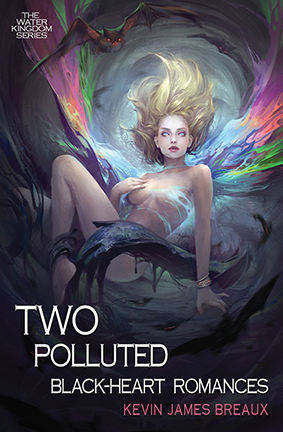

Two Polluted Black-Heart Romances
Welcome to Los Angeles—but not the LA you know. Here, humans coexist with vampires, mummies, fairies, and other nonhuman entities. Everyone’s just trying to get by for the most part—but some are having more difficulty than others.
A vampire named Cade, a fairy named Sabrina, and a mummy named Moselle are on the lam after exposing the existence of the Otherworldly Assembly, a shadowy organization of paranormal beings. The assembly has sent terrifying assassins called wraiths to exact revenge. The nonhuman trio is in for a real horror show, and they don’t know the half of it—another threat looms, and its destructive ambitions are vast.
Meanwhile, a human named Jackson is recovering from a near-death experience. Old memories and new loves flood his brain, and he’s having trouble finding an outlet for all these feelings—that’s when Sabrina the fairy catches his eye.
Two Polluted Black-Heart Romances, a fast-paced adventure filled with high stakes and unexpected twists, continues the action-packed saga that began with One Smoking Hot Fairy Tail. When unimaginable dangers threaten the planet they all share, humans and nonhumans find a common cause and must work together to prevent disaster.


About Kevin James Breaux:
Kevin James Breaux has written seven books and devoted the past eight years of his life to crafting short stories and novels. He is a member of the Horror Writers Association, and the Science Fiction and Fantasy Writers of America.

Breaux is always enthusiastic about the challenge writing presents. He lives by the motto “Write Makes Might!”© and sees each new page as an opportunity to improve and advance.

Find Kevin James Breaux:
www.kevinbreaux.com
www.lbifw.com
Twitter:  @kevinbreaux


Learn more about One Smoking Hot Fairy Tail at: www.onesmokinghotfairytail.com

Purchase One Smoking Hot Fairy Tail:

Monday, April 24, 2017

Mythical Monday #75 - A Mantichor in Valdur

Art work by: @Burntlaughter on Twitter

It seems there are many books influenced by or based on Myths and Mythological Beings.

There are many different Mythology's and Mythological Beings recorded. Some are very popular and well known, others not so much. There are many similar beings, yet different depending on the culture it’s based in.  The definition of Myth covers about anything in the Urban Fantasy/Fantasy realm to me.

I’ve invited authors to share briefly the Mythological being or Myth that influenced their character(s) or story, or what their character(s) are based on influencing their books.  Hosting here, one author and being or myth per week.


Mind the mantichora

There’s a small menagerie of mythological creatures in both my Valdur books: The Guns of Ivrea and the just-published Witch of Torinia. Although these are epic fantasy, I have tried to create what could be called “retro” epics, and retro in two senses. First, they have a feel of Sixties or Seventies fantasy in the way they are structured and in their characterizations. Second, they try to evoke a fantasy Renaissance world, a world that would have been understood by readers living in the 15th and 16th centuries. As such, I wanted to use several creatures that were known to people in the medieval and late-medieval eras through manuscripts such as bestiaries. Indeed, a few play critical roles in moving my plots along but one creature stands out above the others.

The mantichora was a fabled beast of ancient Persia, similar to the sphynx. A true chimera, it had the body of a lion and the head of a man albeit one equipped with a mouth from ear to ear and triple rows of sharp teeth. In a mythological sense, it was simply a terrifying maneater possessing no special powers nor capable of reason or speech. For providing a monster to terrify the protagonists it certainly fit the bill however I needed to give it purpose so it could play a more useful and integral part in the story. The key to enabling this was that the mantichora was part human. My mantichora has not just the power of speech, it also possesses great wisdom and knowledge despite being a rather amoral, distant, and fickle creature partial to eating people and anything else it can catch. I also gave it an exceedingly long lifespan measured in centuries. I gave it a sense of smell second to none as well as a sixth sense in that it can read the character and past misdeeds of those it encounters.

Indeed, my mantichora isn’t shy about revealing the true likeness of people. In one scene, set in the vastness of a deep forest, it strips bare the cover of one of the main characters, a turning point in the novel. In other scenes, in the best sense of the archetypal fairy tale, it strikes a bargain to spare the life of its victims, with far-reaching consequences. As writers, we can take mythological creatures and make them more than just literary furniture. By endowing them with intelligence, emotions, and motives, we can truly make them part of the story.

The Guns of Ivrea (2016) and The Witch of Torinia (2017) are published by Solaris Books and available through Barnes & Noble, Waterstones, Amazon and other retailers.


Book synopsis for Guns of Ivrea:
Acquel Galenus, former thief and now monk of no particular skill, indifferent scribe and even worse chorister, uncovers a terrible secret under the Great Temple at Livorna that could shiver the one faith to its core. A secret that could get him killed. A secret that could enable an older, more sinister form of worship to be reborn...

Pirate princeling Nicolo Danamis, mercenary to the King and captain of the largest fleet in the island kingdom of Valdur, has made one deal too many, and enemies are now closing in to destroy him.
And Citala, fair-haired and grey-skinned, the daughter of the chieftain of the Merfolk who inhabit the waters of Valdur, finds herself implacably drawn to the affairs of men. She puts events in motion that will end her people's years of isolation but that could imperil their very existence...

All their fates will intertwine as they journey through duchies and free cities riven by political intrigue, religious fervour, and ancient hatreds. Alliances are being forged anew and after decades of wary peace, war is on the wind once again...

Synopsis for The Witch of Torinia:
Lady Lucinda della Rovera, the renegade canoness of St Dionei, secret sorceress of the “old gods”, has cleverly split the One Faith into bitter factions and with the help of a pliant Duke of Torinia, launches a war to overthrow the king of Valdur and bring back the old ways. Brother Acquel Galenus, now Magister of the High Temple of Livorna, knows he must stop her, but doubts his own faith and ability. With powerful demons seeking to reenter the world through Lucinda, he must find allies, but how?

Julianus Strykar, now a coronel of the mercenary company of the Black Rose, finds himself thrust into the maelstrom of civil war but false pride leads him into a battle he may not be able to win -- or survive.

Captain Nicolo Danamis may have regained his fleet and command but the return of his long-lost father and lord, Valerian, has complicated his love affair with mer princess Citala. When his former lover -- the queen of Valdur -- demands his help, he and a suspicious Citala find themselves at the centre of palace intrigue as they try to avert an “alliance” with the predatory Silk Empire that will turn Valdur into a puppet kingdom. And then he learns that the crown prince may be his bastard son.
Friendships, loves, and the future of Valdur all hang by a thread….


Author Bio:
Clifford Beal, an international journalist for 20 years, is a Fellow of the Royal Aeronautical Society, and was the editor-in-chief of Jane’s Defence Weekly in London before turning his attention to writing history, historical fiction and epic fantasy. Over the years he has been flung about in military aircraft, fought in full medieval armour, trained in 17th century rapier combat, fired flintlock pistols, messed about in boats, and ridden both horses and motorcycles. When not writing and imbibing endless mugs of tea he is reading and imbibing endless mugs of tea. He lives in Surrey, England, with a fiery redhead of a wife and a Boston Terrier named Buzz. You can follow his blog at cliffordbeal.com and on Twitter @clifford_beal


Purchase the Books:


Book Depository:
The Guns of Ivrea
The Witch of Torinia

Barnes & Nobles:
The Guns of Ivrea
The Witch of Torinia

Monday, April 10, 2017

Mythical Monday #74 - Tale as Old as Time

Art work by: @Burntlaughter on Twitter

It seems there are many books influenced by or based on Myths and Mythological Beings.

There are many different Mythology's and Mythological Beings recorded. Some are very popular and well known, others not so much. There are many similar beings, yet different depending on the culture it’s based in.  The definition of Myth covers about anything in the Urban Fantasy/Fantasy realm to me.

I’ve invited authors to share briefly the Mythological being or Myth that influenced their character(s) or story, or what their character(s) are based on influencing their books.  Hosting here, one author and being or myth per week.


Tale as Old as Time:
The Tragedy of Tristan & Iseult


“King Mark carries the bodies of Tristan and Iseult back to the shores of Cornwall where they are buried side by side. From their tomb grows a vine and a rose that intertwines symbolizing their love. The union after death still angers Mark who constantly has the plants cut back but the vine and the rose continue to grow. A symbol of the strength of the love between Tristan and Iseult.” - Celtic Legend, The Vine and the Rose


Before Romeo took a poisoned vile and Lancelot stole the forbidden heart of Guinevere, there was the legend of Tristan and Iseult. A tale made popular in the 12th century through Anglo-Norman literature, and perhaps most famously as a 19th century opera by Richard Wagner. Tristan & Iseult is a tragic romance, that has withstood the test of time

A chivalrous figure often associated with Arthurian legend, Tristan was a noble knight, a hero of the British isles and a trusted envoy of his uncle, King Mark of Cornwall. Tristan was chosen by his uncle to escort the Irish princess, Iseult, back to Cornwall to become King Mark’s bride. However, as often happens in legends of tragic romance, Iseult's fate and magic dictate a different course for the knight of Cornwall and princess of Ireland. During their journey, a magical love potion intended for Iseult to share with King Mark on her wedding night is accidentally drank by Tristan and Iseult. From that moment on, their hearts become irrevocably intertwined.

Tristan’s desire for Iseult brings great shame to the Arthurian knight, who loves Mark both as a nephew to his uncle and knight to his king. A romantic figure, chivalry defined Tristan’s character, yet he was unable to deny his affections for Iseult. The two become lovers and their betrayal is eventually discovered by the king. As a result Tristan leaves Cornwall and journeys to the court of King Arthur, leaving Iseult behind.

Tristan becomes a hero of Arthurian legend, winning many battles and eventually marries. However, the love he continues to carry for Iseult causes his wife to become jealous. A jealously which manifests after Tristan is poisoned and must return to Ireland for the healing arts known only by Iseult.

Sailing back to Cornwall, Iseult is sent a message of Tristan’s ailment. She is asked to fly a white flag if she will come to him, and a black flag if she no longer loves him. When the boat approaches, the flag is white, however Tristan’s jealous wife lies, stating that the flag is black and Iseult has refused to come to Tristan’s aid. Upon hearing the lie, Tristan dies moments before his love reaches his side. At finding him dead, Iseult’s heart breaks and she joins him in death.

They are buried side by side. Legend says there grew a vine and a rose constantly intertwined, symbolizing the power of their love. The vine and rose were said to be enchanted, as no matter how many times the plants were cut back they always reappeared, forever uniting the lovers.

The first time I heard this legend was shortly after moving to Ireland. I was enthralled by the tragic Black Rose Guard dark fantasy series. Black Rose is the tale of two captains of the immortal guard, Mara and Edward, continually separated by honor, duty and fate. Their love is symbolized by enchanted, immortal roses which appear whenever the lovers have need of them.
romance, the beauty of the immortal love that transcended time and the profound image of the vine and rose forever intertwined. This legend inspired me to begin writing the

Their story takes inspiration from Tristan and Iseult. For one, Mara, like Tristan, is a knight of the realm and blood relative to the ruling monarch, though the genders have been switched for the nephew and king. Also, much like Tristan’s love of Iseult, Mara’s love for Edward is forbidden by royal decree.

To separate the lovers, the queen sends Edward, on a dangerous quest, taking him far from his love. As he attempts to return, Edward is captured by a rival royal court and held for many years. The enchanted roses however, refuse to accept the separation of the lovers and appear in Edward’s cell and grant Mara visions which eventually lead her to save the man she loves.

In my fictional world, the roses themselves become a living entity. They whisper prophecy and glimpses of the future to those chosen few known as the immortal rose heirs. In exchange for these glimpses, the roses feed on blood of the heirs. Some see this connection as a blessing, but others, like Mara, view it as a curse. This results in the roses feeding from the reluctant princess by force.

The association with death and the roses also exists in my series, as the roses turn black at the death of one of their chosen, Princess Liza. After Liza’s death, Mara embarks upon a quest to avenge her death which was committed by another of the roses chosen. The fight between the two rose heirs is among the most devastating in the royal courts, and a battle from which none escape unscathed.

The Black Rose Guard, was heavily influenced by the story of Tristan and Iseult. Like the doomed lovers of legend, Mara & Edward’s struggle to maintain their forbidden love. The symbolic unity of the roses is also drawn form this ancient story of the Irish princess and Arthurian knight, a reflection of the ebony and crimson blooms which sway the love of Mara and Edward in my own story of immortal devotion and tragic desire.


About K.L. Bone:
Bone has a master’s degree in modern literary cultures and is working toward her PhD in literature. She wrote her first short story at the age of fifteen and grew up with an equally great love of both classical literature and speculative fiction. Bone has spent the last few years as a bit of a world traveler, living in California, London, and most recently, Dublin. When not immersed in words, of her own creation or studies, you’ll find her traveling to mythical sites and Game of Thrones filming locations.

Find K.L. Bone:
Her Site
Twitter:  @kl_bone
Facebook Author Page
Goodreads
Amazon

Purchase The Black Rose Guard books:


Monday, April 3, 2017

Mythical Monday #73 - Frankenstein's Monster

Art work by: @Burntlaughter on Twitter

It seems there are many books influenced by or based on Myths and Mythological Beings.

There are many different Mythology's and Mythological Beings recorded. Some are very popular and well known, others not so much. There are many similar beings, yet different depending on the culture it’s based in.  The definition of Myth covers about anything in the Urban Fantasy/Fantasy realm to me.

I’ve invited authors to share briefly the Mythological being or Myth that influenced their character(s) or story, or what their character(s) are based on influencing their books.  Hosting here, one author and being or myth per week.


Frankenstein's Monster

It’s not often we get to add to the ranks of the mythical creatures, but back in 1818 one young woman did just that. Her name was Mary Shelly, and the book that created a new legend was Frankenstein; Or the Modern Prometheus.

Written on a bet, on a literal dark and stormy night, it birthed a creature that has become a staple of our nightmares. The monster made from the dead, cobbled together into a semblance of humanity, and full of rage at his creator.

I have always been fascinated by Frakenstein’s Monster. Written by a young woman after a dream, he has imbedded himself in our subconscious just as deeply as mermaids and dragons.

In the book one thing is clear; the monster is not Frankenstein, Frankenstein is the doctor who made him.

In the book, the doctor’s creation is called monster, creature, and a host of other unfriendly terms. It marks out humanity’s inhumanity that he doesn’t even get a proper name.

Frankenstein decides to create his monster out of obsession and grief, but cannot take how ugly and terrifying he seems once he arises. Well he did make it out of bits and dead pieces so what did he expect?

The monster embodies mankind’s hubris, taking god’s place in giving life.

All of these attributes ended up in someway in my latest book, Immortal Progeny.

I started with this understanding of Frankenstein’s monster, but I wanted to take the themes of that original book, make them even larger, and move them into a fantasy setting full of magic.

In Immortal Progeny, there is a world of monsters. Just like Shelley’s creature they are created out of hubris. Priests and priestesses make these progeny out of the dead, and use them to fight each other for supremacy.

In this world they can stand for there to be only one religion, and war rages over the continent until one is left.

In the eyes of the temples, the use of the dead is a glorious thing since it is used for the glory of their particular god. Never mind the fact they are killing to provide the parts they need.

However it isn’t just progeny. Smaller creations, made of purely human parts, are much more like Frankenstein’s monster. These are called homunculi and are even more frightening I think. Imagine if people who you thought were dead and buried can suddenly be transformed into shambling, stinking, stitched creatures.

Even if the monsters are propelled by magic rather than the wonders of electricity in Shelley’s novel, there are all the same questions to be asked.

Just because you can do something, should you? If you are creating life are you a god…or a monster yourself?


About Pip Ballantine:
New Zealand born fantasy writer and podcaster Philippa (Pip) Ballantine is the author of the Books of the Order and the Shifted World series. She is also the co-author with her husband Tee Morris of the Ministry of Peculiar Occurrences novels as well as Social Media for Writers. Her awards include an Airship, a Parsec, the Steampunk Chronicle Reader’s Choice, the RT Reviewer’s Choice Award for steampunk, and a Sir Julius Vogel. She currently resides in Manassas, Virginia with her husband, daughter, and a furry clowder of cats.

Find Pip Ballantine:
Her Site:  http://www.pjballantine.com/
Facebook:  https://www.facebook.com/philippaballantine/
Twitter:  @PhilippaJane
Pinterest:  https://www.pinterest.com/pipballantine/

Purchase Immortal Progeny:


Monday, March 27, 2017

Mythical Monday #72 - Kundalis Dragons and the Kundalini

Art work by: @Burntlaughter on Twitter

It seems there are many books influenced by or based on Myths and Mythological Beings.

There are many different Mythology's and Mythological Beings recorded. Some are very popular and well known, others not so much. There are many similar beings, yet different depending on the culture it’s based in.  The definition of Myth covers about anything in the Urban Fantasy/Fantasy realm to me.

I’ve invited authors to share briefly the Mythological being or Myth that influenced their character(s) or story, or what their character(s) are based on influencing their books.  Hosting here, one author and being or myth per week.


Kundalis Dragons and the Kundalini

Living in the center of Washington State during fire season is like an invitation to write dragons. I come from the soggy, western part of the state originally, and the first time a wall of flame raced across my front yard it just about sent me right back to Seattle.

Now I spend my summers anxiously watching the windows, and even when my own life and limb are blissfully safe from incineration, the distant plumes of smoke are pretty much always a thing from May to Sept. Fire. Everywhere. Like clockwork.

Given the situation, I think it was pretty inevitable that I'd get around to writing dragons.

The Kundalis dragons in my Soulstar series, do their singeing and battling over the dry grasslands of the Columbia Basin. They aren't ordinary fire-breathers, though. I needed something a little different for a sassy urban fantasy with metaphysical overtones. I wanted dragons that stood for something, and also, that echoed the strengths and the flaws of the characters attached to them.

I found them in the Kundalini serpent.

Kundalini is the Sanskrit word used to represent personal energy. It has other names, of course, Shakti, Chi or Qui as well as many others. In traditions that focus on enlightenment through the raising of one's energy, this Kundalini is often symbolized as a big snake. Eureka.

The Kundalini serpent is said to be coiled at the base of a person's spine, in their "energy body," and through meditation techniques can raise up through the chakras toward the crown of the head. The higher the snake rises, in essence, the more evolved and blissful the person becomes.
This awakening and progression of the serpent rapidly became the idea for my dragons. What happens if the serpent gets free? What if the person isn't so enlightened, and the Kundalini awakens anyway? On a lighter note, what sort of trouble could a rampaging Kundalini serpent get its owner into in the middle of Eastern Washington.

It turns out, quite a lot.

Since I was writing chick-lit and hoping to keep it humorous, the invisible Kundalis manifested with a bit of an attitude. They remain affiliated with metaphysics, but also bring with them the hang-ups, flaws and personality disorders of their owners. They fully controlled dragon attaches to his host by means of a tail tip through the navel, and the chakras translated into the colors of each dragon, lending each the powers related to their particular flavor of energy.

I found out later that the word, Kundali, is also a reference to Vedic astrology. In parts of India, Kundali matchmaking is used to ensure the astrological compatibility of couples before marriage. This idea becomes the soul mate concept in the Soulstar books. The dragons' compatibility or discord translates into the inter relationships of their "anchor" characters.

The mythology of energy became the core of my dragons, complete with some pretty suspicious claims of enlightenment. The interaction between their owners became a statement on compatibility and the complexity of human interaction. From the Kundalini serpent, the Kundalis dragon took shape.

What do you get when you mix metaphysics, yoga, and urban fantasy? I got giant, invisible, belly button dragons... and a ton of metaphysical chaos.


About Author:
Frances Pauli writes across multiple genres. Her work is speculative, full of the fantastic, and quite often romantic at its core. Whenever possible, she enjoys weaving in a little humor.

Once upon a time she was a visual artist, but she’s since come to her senses. Now she fills her minuscule amount of free time with things like crocheting, belly-dancing, and abysmal ukulele playing.

Find Author:
Author Site
Twitter:  @MothinDarkness
Facebook Author Page


Purchase Books:


Mythical Monday #71 - Valkyries

Art work by: @Burntlaughter on Twitter

It seems there are many books influenced by or based on Myths and Mythological Beings.

There are many different Mythology's and Mythological Beings recorded. Some are very popular and well known, others not so much. There are many similar beings, yet different depending on the culture it’s based in.  The definition of Myth covers about anything in the Urban Fantasy/Fantasy realm to me.

I’ve invited authors to share briefly the Mythological being or Myth that influenced their character(s) or story, or what their character(s) are based on influencing their books.  Hosting here, one author and being or myth per week.


Valkyries.

Growing up, I played a lot of RPG games; both pen and paper and video games. I remember my earliest exposure to Norse mythology, Vikings and Valkyries was in a Dungeons and Dragons manual called Deities and Demigods published in 1980 by TSR Games.

I was very young at the time, but I had a friend who was a couple years older and he liked to give me these D&D books as gifts. This one held my attention for hours and hours, days and days…all the way through high school.

The art was simple pen and ink drawings, but the pictures depicted gods and goddesses from different belief systems and cultures. My favorite back then was the Greek and Norse gods. Oddly enough, still is now.

On the page that listed Valkyrie “Choosers of the Slain” there was a big piece of art. It showed a bunch of women on winged horses carrying dead soldiers. I was intrigued. Where could I find more?

Sadly, I never read much more about them. I don’t think I had seen any movies about or with valkyries in them either. I had only heard a few stories from my friend who was well-read and educated.

It wasn’t until I was a few years older that I was given a Boris Vallejo calendar. It was then that I truly started to fall in love with fantasy art, and started to see more examples of valkyries.

To this day, I have only a fuzzy recollection of mention of valkyries in a few movies. Can’t really recall if I saw them in any films or cartoons. Weird.

So when I decided to write a new Dark Fantasy - Horror novel a few years ago, I came up with the idea of using valkyries as one of the themes. I wanted to write a story about a warrior woman who was abducted from battle. But by who, why, how?

I like to research. But I like to research facts. Then, when writing fiction, decide which facts to add and which facts to alter. I could shape my world into the Viking Age…make few changes to history here and there. No problem. But as I began to research Valkyries, I kept falling into that same Google trap over and over…Operation Valkyrie…not what I was looking for…but what always popped up. So eventually I decided to create my own myth around what little I knew.

They were strong, yep! They had classic Viking-opera armor, yep! They were beautiful, and they flew…in some capacity they flew. Great!

I ordered and skimmed through a Norse Mythology book, it linked valkyries to the goddess Freyja. Perfect. That was all I needed to know.

I sat down one afternoon and sketched out my ideas. I tried to blend all the fantasy art I had seen growing up into an amalgamated vision of a valkyrie. What I came up with was a warrior women who was not only a “chooser of the slain” but a protector of the innocent. Tall and strong. With large magical wings that when summoned appeared out of her back. A being who could traverse the world of the living and dead as well as the realm of the gods, yet only when called by their master, the Goddess Freyja. I considered what other powers would this mythical being have—well, akin to an angel, I figured the ability to heal and the ability to calm, or sway a man’s mind.

Of course, my vision of a valkyrie could fight. So she needed arms and amour, all of which I imagined as bestowed upon her by Freyja. The valkyrie would have magical armor that the woman could grow or shrink—wear or hide. As well as a kind of “holy spear” weapon that could be summoned when needed. Again, I saw my valkyrie as very angel-like.

Would she be invulnerable? Would she actually carry the bodies of men to Valhalla? Would this be a blessing or a curse for her? Who would be her natural enemies if she had them?

I don’t want to spoil too much. See, the main character of THE LIFEBLOOD OF ILL-FATED WOMEN, Astrid, is struggling to figure what is real and what is not. Is she alive? Is she dead? What happened to her when she vanished from the battlefield? And why is she so far from home now?

The Lifeblood of Ill-Fated Women is set in the Viking Age and filled with Norse Mythology. It is a Dark Fantasy novel with elements of Horror and Romance. I hope you check it out. Thanks

About Kevin James Breaux:
Kevin James Breaux has written seven books and devoted the past eight years of his life to crafting short stories and novels. He is a member of the Horror Writers Association, and the Science Fiction and Fantasy Writers of America.

Breaux is always enthusiastic about the challenge writing presents. He lives by the motto “Write Makes Might!”© and sees each new page as an opportunity to improve and advance.

Find Kevin James Breaux:
www.kevinbreaux.com
www.lbifw.com
Twitter:  @kevinbreauxhttps://twitter.com/kevinbreaux

The Lifeblood of Ill-Fated Women
For Astrid, there is no greater honor than dying as a true Viking warrior and ascending to Valhalla. She anticipates it in every battle and is always eager for the next fight. When she hears the sounds of war outside her father’s stronghold of Birka, she answers the call. But a golden light envelops her, and she is suddenly gone.

If that light had taken her to Valhalla, she would have been at peace.

Instead, this golden light dumps her into a snowy, awful, godforsaken land. Astrid has no idea where she is or how she got here. She begins to suspect that she is in Hel, the underworld of Norse mythology. As Astrid searches for her home and family, a farmer, Warren, comes to her aid. Astrid doesn’t trust him at first, but she will have to rely on Warren and other companions when her destiny reveals itself.


Purchase the book:


At Barnes & Nobles

Monday, March 20, 2017

Mythical Monday #70 - Shifters and Skinwalkers

Art work by: @Burntlaughter on Twitter

It seems there are many books influenced by or based on Myths and Mythological Beings.

There are many different Mythology's and Mythological Beings recorded. Some are very popular and well known, others not so much. There are many similar beings, yet different depending on the culture it’s based in.  The definition of Myth covers about anything in the Urban Fantasy/Fantasy realm to me.

I’ve invited authors to share briefly the Mythological being or Myth that influenced their character(s) or story, or what their character(s) are based on influencing their books.  Hosting here, one author and being or myth per week.


Shifters and Skinwalkers

My YA Paranormal Mystery series in which SHADE is the first novel features a number of myths and mythological beings. The main character, a teenaged girl named Shade, discovers in the first book that she’s a ghost whisperer. This means that she can see and hear ghosts. Ghosts reach out to her when they need help resolving issues from their lives on Earth before they can move on into the afterlife.

By Book #2, SHADE AND THE SKINWALKERS, Shade discovers there are more mythological beings roaming the Earth. In this book, she encounters shifters and skinwalkers for the very first time.

There’s an important difference between these two creatures. While shifters are mythological, skinwalkers are part of Navajo religious and cultural lore.

Shifters have much in common with several of Carl Jung’s archetypes. They seem to have most in common with the Shadow archetype. In Jung’s own words, “Taken in its deepest sense, the shadow is the invisible saurian tail that man still drags behind him. Carefully amputated, it becomes the healing serpent of the mysteries.” The Shadow represents the shadowy parts of ourselves that we don’t like to recognize as being parts of ourselves. It represents the wild, chaotic impulses that we tend to deny and push down into our unconscious. This archetype is perfect for fictional stories in which the Shadow can be released and given full rein. In shifter stories, human beings shift into animal form. In animal form, they can do either good or bad; but, no matter what, they’re frightening, as they’re no longer tied to the norms of human society. SHADE AND THE SKINWALKERS includes both good and bad shifters. There’s a cute little cat; but there are also much larger, more vicious animals into which shifters change form.

Other Jungian archetypes that shifters represent are the Magician which is described as mysterious and powerful, the Witch or Sorceress which is described as dangerous, and the Trickster which is described as deceiving and hidden.

When human characters have the magical ability to shift into animal form, they add an important element to literature. By reading about episodes of shifting and morphing into animal form, we’re able to vicariously tap into our own dark impulses, to see them in action and process them. While observing or becoming one with the Shadow, the Magician, the Witch/Sorceress and the Trickster, we feel thrilled and frightened. We understand, even if only on an unconscious level, more about ourselves and the human condition.

Skinwalkers are a step beyond shifters. In Navajo religion and cultural lore, skinwalkers are evil witches capable of shifting into animal form. They don’t simply morph into animal form because that’s part of their biological makeup, as is the case with shifters. It’s believed by the Navajo that there is, instead, a period of time in which a human being must violate societal taboos to prove worthy of becoming a skinwalker. It’s often felt they must go as far as committing horrific crimes such as cannibalism, incest or murder against their own kin in order to become a skinwalker. Understandably, the Navajo are quite frightened of these creatures.

Adding both shifters and skinwalkers to my YA Paranormal Mystery novel, SHADE AND THE SKINWALKERS, allowed me to explore a great many themes about friends and families, good vs. evil, and heroes and villains.


About Author:
USA TODAY Bestselling Author Marilyn Peake writes in a variety of genres, mostly Science Fiction and Fantasy. She’s one of the contributing authors in Book: The Sequel, published by The Perseus Books Group, with one of her entries included in serialization at The Daily Beast. In addition, Marilyn has served as Editor of a number of anthologies. Her short stories have been published in seven anthologies and on the literary blog, Glass Cases.

Find Author:
Author Site
Twitter:  @marilynpeake
Facebook Author Page

Purchase Books:


Monday, March 13, 2017

Mythical Monday #69 - The Myth of Samurai

Art work by: @Burntlaughter on Twitter

It seems there are many books influenced by or based on Myths and Mythological Beings.

There are many different Mythology's and Mythological Beings recorded. Some are very popular and well known, others not so much. There are many similar beings, yet different depending on the culture it’s based in.  The definition of Myth covers about anything in the Urban Fantasy/Fantasy realm to me.

I’ve invited authors to share briefly the Mythological being or Myth that influenced their character(s) or story, or what their character(s) are based on influencing their books.  Hosting here, one author and being or myth per week.


The Myth of Samurai

When Melissa came to me and asked me to contribute to mythical Mondays, I was excited. You see, I believe that the stories and myths that we read and tell ourselves have a deep impact on the way we view the world.

Today I decided to write about the samurai, the warrior class that dominated Japan’s culture and politics for hundreds of years. It may seem a strange topic for mythical Monday, being as the samurai definitely existed, but bear with me for a moment.

For as long as I can remember, I’ve been obsessed with samurai. Not ninjas, not knights, not any other type of warrior society throughout history. Just samurai.

I grew up on a steady diet of samurai pop culture, from books to anime to movies. I loved the idea of a warrior class, bound by honor and duty. I loved the weapons, particularly the katana. I loved the idea of two warriors fighting each other while others watched on, bound to accept the fate of the fight. You see, what I loved was the idea of the samurai.

I’m older now, and what I’ve realized is that the samurai have obtained a pseudo-mythical status, particularly in Western culture. What many of us think and believe when we think of samurai is no more real than vampires and werewolves battling for the hearts of teenagers.

In reality, samurai were human, and as such, were deeply flawed. They were corrupt, violent, and used their power to evil ends. They were also skilled warriors, capable of great deeds and great art. In short, they were as good or evil as anyone else. The reality of the samurai is nowhere near as inspiring as the tales we tell about them.

But I’ve also found peace with that idea, because even if the samurai, as we think of them, are a myth, they are also an ideal for us to strive for. If we can grow up to be strong, honorable people capable of great sacrifice and great art, our lives will be much the better.

It was this idea that was the seed that led to Nightblade, my debut fantasy novel. I didn’t want to write about the samurai or Japan, because I’m not an expert, and it would be an injustice for me to try. But I wanted to write about the ideals the samurai myth gives us. I wanted to create a world where there was a class of people gifted with skills beyond the average citizen, and wanted to see what such a world would look like.

I think that the power of myth is that it gives us a new way to view the world. Even if the samurai (as I thought of them) weren’t real, they shaped the way I wanted to grow up, and for that, I shall always be grateful.


About the Author:
Ryan Kirk is an author and entrepreneur based out of Minnesota. He is the author of the Nightblade series of fantasy novels and the founder of Waterstone Media.

He has been writing for longer than he can remember. His first attempts at stories were written in the third and fourth grade, but he is pretty sure he doesn’t remember anything before high school.
Ryan has always been a fan of science fiction and fantasy stories, and adventures in particular. He loves writing, traveling, and being outside as much as possible.

He also finds it incredibly challenging to write about himself in the third person.

Find the Author:
Twitter:  @Waterstonebooks
Author Site

Purchase the Books:
 

Monday, February 27, 2017

Mythical Monday #67 - Mythology in Science Fiction

Art work by: @Burntlaughter on Twitter

It seems there are many books influenced by or based on Myths and Mythological Beings.

There are many different Mythology's and Mythological Beings recorded. Some are very popular and well known, others not so much. There are many similar beings, yet different depending on the culture it’s based in.  The definition of Myth covers about anything in the Urban Fantasy/Fantasy realm to me.

I’ve invited authors to share briefly the Mythological being or Myth that influenced their character(s) or story, or what their character(s) are based on influencing their books.  Hosting here, one author and being or myth per week.


Mythology in Science Fiction

I primarily write science fiction, which – on the surface – does not appear to be based on mythology at all. SF is often thin on religion and spirituality, and appears to be far more linked to engineering than to myth.

But there are a few myths that infuse science fiction. I’ll illustrate how they’ve impacted my work, and I would be interested in what others think about how mythology applies to other SF work. I’ll start off by admitting that the link is slant – I can’t tie my work to myth quite as directly as Patty Briggs or Charles deLint (two of my favorite fantasy writers).

The working title for my first book (a collaboration with Larry Niven titled Building Harlequin’s Moon, actually included the word Myth. We called the manuscript Creation Myth, and the publisher later renamed it. In that book, we literally create a habitat from a moon of a gas giant planet (thus creating an ecosystem on a rather large rock). It takes a mythic amount of time (thousands of years) and of effort and power. We had to bombard the moon with comets. I actually think Creation Myth was a more apt title. Every society has its creation myths, and what might a world created by a travelling starship make of their history?

The opposite of creation, destruction (the apocalypse) is a common myth. We see it in Christianity, and it even infuses out politics (there are stories that Bannon, a Presidential advisor, believes we are close to the end of days). Most societies with creation myths also have destruction myths. In my recent YA novel POST (from eSpec Books), I talk about a time when we are picking ourselves up after a fall. Themes are about rebuilding and persevering, but those would not happen without the original disasters that drove the global economy to its knees before POST starts.

In Wilders, coming out in June from Pyr, I play with the same themes in a very different setting (the timing of the two stories could be considered equivalent, but on different branches of the future as the world building for each is very different). The world in Wilders has a massive land re-allocation in its past, where most people were scooped into cities and most land into “rewilding” projects. All does not go well. Again, the apocalypse does not solve our problems.

Myths don’t have to come from the far past. I think we have a current social myth that robots are going to take over the world. While it’s not historical, it’s pervasive, and may or may not be wrong. Since I’m not sure, I write about it a lot. It’s a main theme for the linked novels Edge of Dark and Spear of Light, and also for a lot of my stories, including a favorite of mine, “The Robot’s Girl.”

And then there is the great technology myth of the singularity. No one quite knows what it is (except maybe Ray Kurzweil and Vernor Vinge), or even whether or not it’s a good thing. But it’s also a cornerstone idea in Edge and Spear. Books praising the singularity are common, and so are stories about how it might not solve all of our problems (or might not solve any of our problems).

A last comment that I’ll make is that we probably ought to address mythology more in science fiction. UFOs are a myth (or not). The pyramids may have been built by aliens (or not). We may emerge from our caves and our tribes and our towns and our cities and become members of an intergalactic society, although whether or not we’re welcomed there may depend on how well we do with the globalization that is vexing us so much now. And some of growing up is adopting current mythology. Are we kind and capable or are we insane and dangerous?


About the Author:
Brenda Cooper writes science fiction and fantasy novels and short stories, and sometimes, poetry. Her most recent novel is Spear of Darkness, from Pyr and her most recent story collection is Cracking the Sky from Fairwood Press. Brenda is a technology professional and a futurist, and publishes non-fiction on the environment and the future. Her non-fiction has appeared on Slate and Crosscut and her short fiction has appeared in Nature Magazine, among other venues.

See her website at www.brenda-cooper.com.

Brenda lives in the Pacific Northwest in a household with three people, three dogs, far more than three computers, and only one TV in it.


Purchase the Books:


Monday, February 13, 2017

Mythical Monday #65

Art work by: @Burntlaughter on Twitter

It seems there are many books influenced by or based on Myths and Mythological Beings.

There are many different Mythology's and Mythological Beings recorded. Some are very popular and well known, others not so much. There are many similar beings, yet different depending on the culture it’s based in.  The definition of Myth covers about anything in the Urban Fantasy/Fantasy realm to me.

I’ve invited authors to share briefly the Mythological being or Myth that influenced their character(s) or story, or what their character(s) are based on influencing their books.  Hosting here, one author and being or myth per week.


Writing the Violent Fairy

I had never heard of a filandiere before Danielle Ackley-McPhail assigned me the faeries of the realm of spirit for a Bad-Ass Faeries anthology. From the list, I chose the name because it sounded interesting, wispy and ethereal.

According to Mostropedia.org, a filandiere consumes creativity. She draws nourishment from art, music and other evocations of the mind and heart. Those are food to this kind of faerie. If there is no inspiration, then the faerie goes hungry.

I decided to write a story in which a creator and a filandiere had a symbiotic relationship. Ninette, the faerie, was Marcel’s agent. Like any agent, she took fifteen percent of everything, including the creative spirit that went into his work. At the same time, she inspires him, giving him experiences that he uses to inform his work, experiences that no one else can ever have.

Like many humans, when a filandiere doesn’t get enough to eat, she gets cranky. That rebounds upon her hapless client. But because of her powers, she can provide him with the inspiration he needs to keep going. It’s a devil’s bargain for Marcel as well as Ninette. They are tied together in a mutually supportive but abusive relationship. I found it interesting to write, as I could easily see where a desperate writer would make such a bargain for fame, fortune – and food. Their relationship is functional and fruitful, but you can’t really call it a healthy one.

Because the name of the faerie was French, I set the story in the French Quarter of New Orleans. I know or knew plenty of writers and musicians who live and work there. Creativity booms, although many of the creatives eke out a marginal existence. Marcel is one who was raised from relative poverty. He wants to let go of the being who both succors and sucks from him, but he can’t. She’s the only thing keeping him writing.

Curiously enough, Monstropedia.org was the only place I found an entry about filandieres. I have never found another reference (at least in English). Monstropedia has disappeared from the web. Like a faerie, it has vanished away, leaving only a memory, but it was an inspiration to me when it existed.


Back the campaign:  Make 100: The Best of Bad-Ass Faeries

Visit me on the web at:
Facebook: https://www.facebook.com/jodylynn.nye
Twitter: @JodyLynnNye
Goodreads: Jody Lynn Nye
Amazon Author Page: https://www.amazon.com/Jody-Lynn-Nye/e/B000AQ0B5I/ref=sr_ntt_srch_lnk_1?qid=1486753979&sr=1-1
Site: Jody Lynn Nye